
If you want to learn to play the bagpipes, it’s important to understand the origins of your instrument. Folk.World has compiled fingering charts for two types of bagpipes.
The bagpipe does not come (only) from Scotland. It exists in countless variations, shaped by the many folk music traditions around the globe. Being aware of this is very important when starting to play the bagpipe. In Europe, the Scottish Great Highland Bagpipe is very well known. Equally well known among enthusiasts are the medieval market bagpipe, the French shepherd’s pipe, the Spanish gaita, and the Swedish säckpipa.
The following fingering charts will help you to learn the scale of the Wee-Pipe or German-Smallpipe.
Scottish bagpipes
The Scottish bagpipes—which include the Great Highland Bagpipe, the Scottish Smallpipe, and the Scottish Wee-Pipe—are played using a semi-closed fingering technique. This means that in the upper half of the scale, the lower hand closes the holes on the chanter again. The corresponding fingering chart shows you the correct fingering:
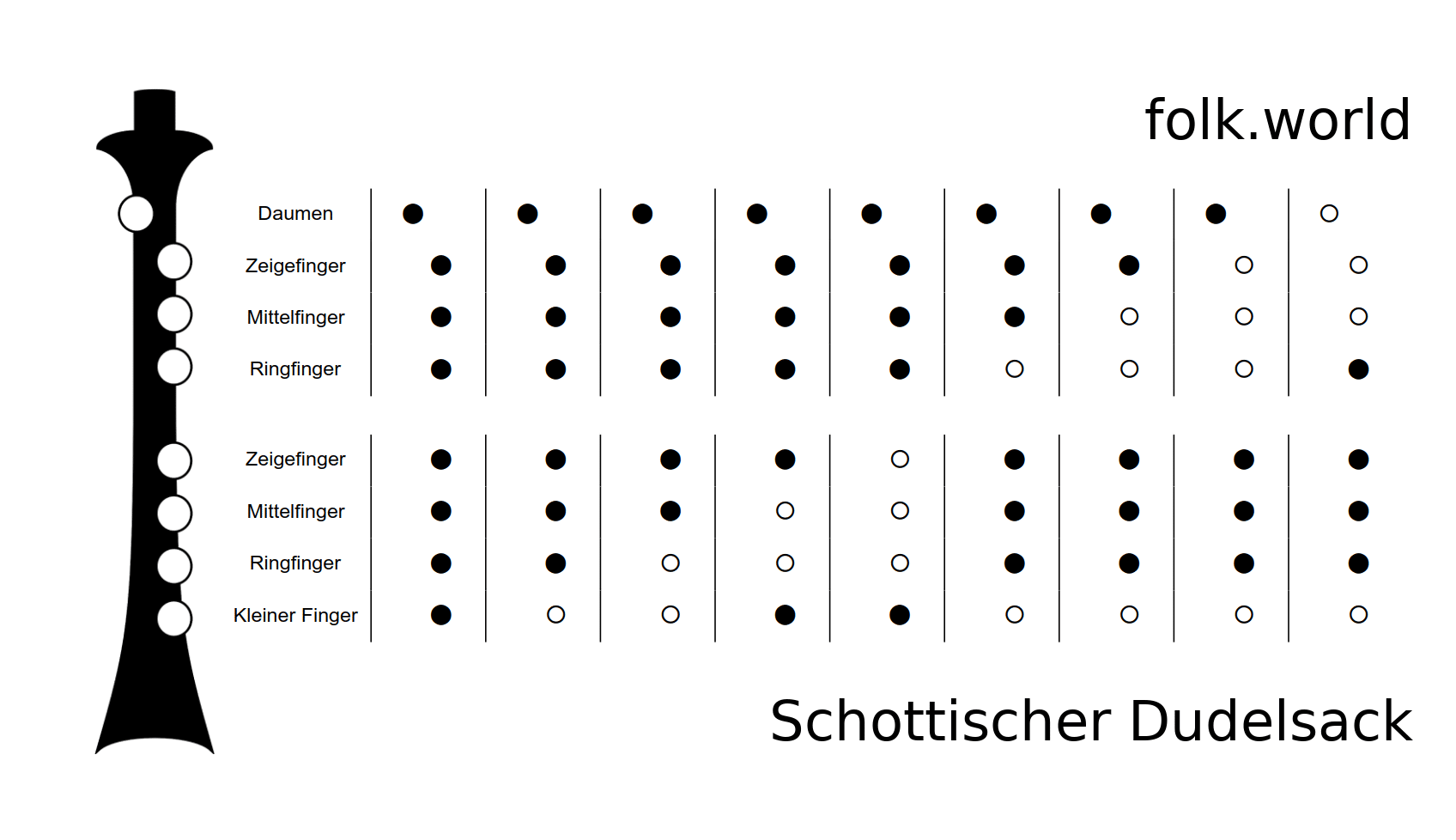
You can download the fingering chart for the Scottish bagpipes here as a PDF.
Medieval bagpipe
Unlike the Scottish bagpipes, the medieval market bagpipe is played similarly to a C recorder. It uses the open fingering. The scale is therefore played upward without the lower hand returning to the chanter. You can see what this looks like in this picture:
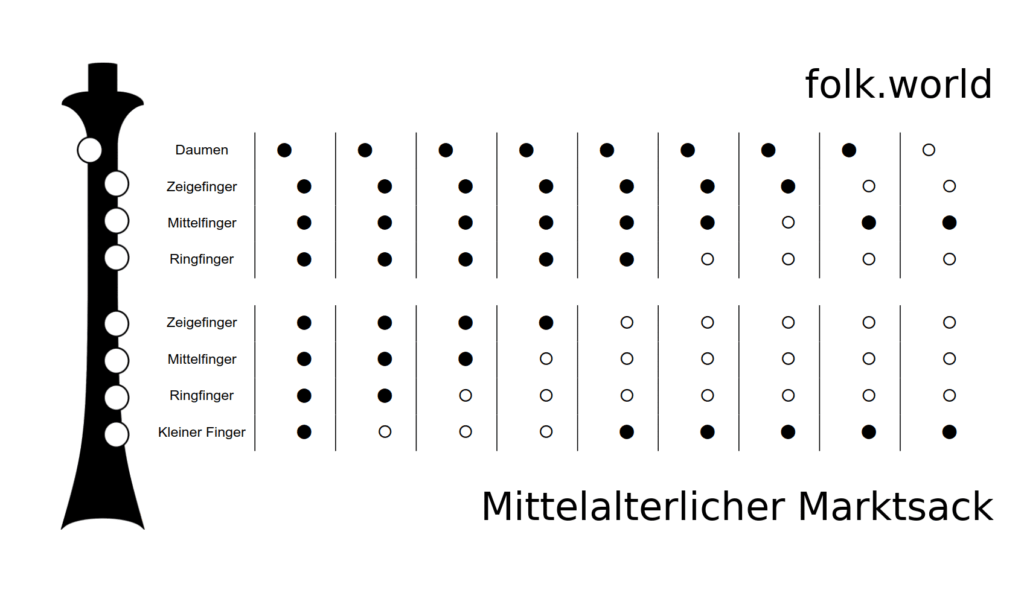
The fingering chart for the medieval bagpipes can be found here as a PDF.

