
Imagine a Scottish landscape with green hills and a real Scotsman standing on one of them. He’s wearing a plaid kilt and a hat—just as he should. Most important, however, is the object he’s holding in his arms. This somewhat strange-looking instrument is called a bagpipe, and every child associates it with Scotland.
But all over the world, it goes by different names: sackpipe, bockpipe, Great Highland Pipe, gaida, bock, sackpfiff, schaleika, säckpipa, or cabrette, to name just a few. Every region has its own story about the bagpipes. What do we actually know about this peculiar woodwind instrument, other than that it immediately makes us think of Scotland? Where do bagpipes really come from, how is a note produced, and how does one become a bagpiper?
Origin of the bagpipe – really in Scotland?

The word “bagpipes” is derived from the Turkish word “duduk,” which means “flute.” Contrary to what many people believe, the bagpipes did not actually originate in Scotland, but likely in Asia. This cannot be said with certainty, as the oldest historical sources usually leave much room for interpretation. The world’s first bagpipes, it is believed, consisted of a simple reed flute and were found in ancient Egypt and early Mesopotamia. It is unclear when the air bag was added to the instrument.
A Hittite relief from Alaca Höyük in the Turkish province of Çorum, dating back to antiquity, depicts a bagpipe—complete with a bellows—for the first time. Dating from before 1200 B.C., it is likely the oldest known depiction of the instrument. Other reliefs and literary works also suggest that the bagpipe originated in Asia. While the instrument was already found throughout the Mediterranean region in antiquity, the Romans spread it throughout Europe. In many European countries, the bagpipe remains an integral part of the culture to this day. It exerted a strong influence on music, primarily in regions with Celtic influences. This is especially true in Scotland, where the bagpipes were even designated the national instrument.
There is one main reason why this instrument—which takes some getting used to—has endured throughout Scottish history. After the Battle of Culloden, wearing the Scottish kilt and practicing many Scottish customs were banned. However, the Scots were still able to play the bagpipes, which allowed them to identify with at least one aspect of their national identity. Today, the whole world knows the Scottish bagpipes—or the “Great Highland Bagpipe”—thanks to British military music.
Bagpipe structure
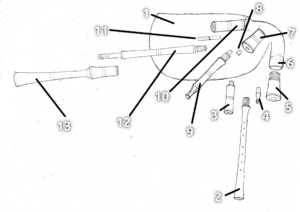
The bagpipe is a continuous-sound aerophone, or a reed instrument. To play it, the air bag must first be filled with air. This can be done in various ways, such as using a bellows or a mouthpiece. If the piper uses a bellows, he can even sing while playing.
A check valve prevents the air from flowing back. To produce notes, the player compresses the bellows with their arms or body, creating a steady air pressure. One or more drone pipes—usually located at the top of the bellows and often resting on the player’s shoulder—therefore produce a constant, sustained tone. This drone, which sounds like a pedal note throughout the performance, is characteristic of the Bockpfeife’s unique sound.
Functionality

The bagpipes’ well-known polyphony is achieved through the melody. This is played on a chanter, just as on a regular flute. The six to eight finger holes on the chanter determine the pitch. To add accents and distinguish the notes of a melody from one another, the player must play numerous grace notes, similar to tied notes. This requires concentration and coordination, as the fingers must be placed at precisely the right moments.
The continuous tone is produced by a single reed in the drone pipes—made of reed, plastic, or metal—which is set into vibration by the airflow. The chanter usually contains a double reed. Such a reed can be compared to that of an oboe. The air bag used to be made of leather, but today it is often made of synthetic material. Many players opt for a decorative cover for their Scottish bagpipes.
The unique musical characteristic—and the challenge—of playing the bagpipes is that the playable keys are limited on many types of bagpipes. Chromatic notes are also often unplayable. Since most bagpipes are tuned diatonically, notes outside the key can only be played to a limited extent. This is one of the reasons why playing the bagpipes requires a high level of skill. In addition, the player must have a large lung capacity. Therefore, beginners are advised not to buy a bagpipe right away, but to take lessons at a music school first. There, students can practice on a training bagpipe.
Types and distribution of bagpipes
[youtube https:=””] A little more than a millennium after the Roman Empire, numerous regional types of bagpipes emerged during the Late Baroque period. They varied depending on the location, era, and the maker’s taste. Today, there are approximately 180 different types of bagpipes throughout Europe. Adapted to modern times, there are even electric bagpipes that can be connected to a computer or amplifier via MIDI.
But let’s first return to the Middle Ages and the early modern period. There, the bagpipes flourished as a folk and shepherds’ instrument and were an indispensable part of the musical landscape. Later, during the Baroque period, the regional variations of the bagpipe gave rise to the Musette de Cour in France, which became the best-known instrument of its kind. Other notable types that emerged from this development include the Bohemian Bock, the Zampogna from Italy, and the Gaida from Bulgaria.
In Central Europe, replicas of historical instruments are still being built today to recreate medieval music. The bagpipes also have a long tradition in Northern and Northeastern Europe, Austria, Southern Germany, India, and Iran. In India in particular—which is believed to be the instrument’s country of origin—playing the so-called “mashak” or “titti” is a cultural custom at weddings. Unfortunately, even in India, these two types of bagpipes have been overshadowed by the Great Highland Bagpipe from Scotland.
A Look at Four Types of Bagpipes
At least 45 regions around the world are known to have their own distinct types of bagpipes. To get a sense of the diversity of bagpipes, we’ll focus on just two of the better-known types from Scotland and Central Europe.
Scottish classic – the Great Higland Bagpipe
[youtube https:=””] The Great Highland Bagpipe is probably the best-known type of bagpipe. It immediately brings to mind Scottish landscapes and men wearing traditional Scottish Highland attire. Originally, it was a popular folk instrument, but from the 19th century onward, it became primarily associated with military music. Starting in the 1980s, the Great Highland Bagpipe—usually made of grenadilla wood—also gained prominence in Germany. Scottish bands and groups were formed, some of which still exist today. The Great Highland Bagpipe consists of two tenor drones, one bass drone, and a chanter with nine notes. Although the bagpipe is tuned to B-flat, most of the music is traditionally notated in A, so the player must transpose. The bagpipes therefore sound a semitone higher than what is written.
The little sister – the Scottish Smallpipe
[youtube https:=””] If you’re looking to switch from the louder Great Highland Bagpipe to a quieter version, the Scottish Smallpipe is a great choice. Thanks to its soft and warm sound, it’s ideal for playing indoors. It also shines when played alongside other instruments. Its versatility is evident not only in the fact that it can be played both by mouth and with a bellows, but also in its tuning. Various fundamental pitches from A to D are possible. Switching from a Great Highland Pipe to a Scottish Smallpipe is straightforward, as the fingering and ornamentation techniques are the same.
Wide range – the shepherd’s pipe
[youtube https:=””] The shepherd’s pipe is a traditional German folk instrument used primarily for dance music. It is slightly louder than the Scottish smallpipe, but still has only a moderate volume. Modern construction is based on the Flemish bagpipe. Since some notes can be overblown, the instrument has a wide range in which almost all semitones can be played. In addition, like the Flemish bagpipe, the shepherd’s pipe offers good stability and the wide range mentioned above. The shepherd’s pipe is often played alongside Drehleier, violins, or other folk instruments.
The French Cabrette
[youtube https:=””] From the late 19th century to the early 20th century, the cabrette made its way to Paris. At dance events there, it was usually played alongside an accordion. This type of bagpipe consists solely of a bellows and a chanter, which is connected to a single drone pipe. In some cases, decorative drones are even attached, though they serve no functional purpose. Initially, the cabrette was a mouth-blown instrument; later, it was equipped with a bellows. This is said to be the work of the carpenter Joseph Faure. He was the first to use a bellows because he suffered from a lung disease.
Related instruments
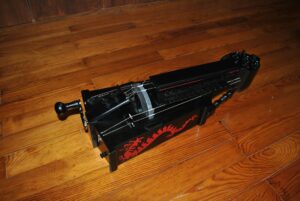
The sound of the bagpipes is probably unlike that of any other instrument. However, the way sound is produced—or the playing technique—is not unique. We are familiar with playing using a bellows, for example, from the organ and the accordion. Instead of an air sac, the Platerspiel uses an animal bladder as an air reservoir. Other drone instruments include the hurdy-gurdy, the drone zither, and double flutes. The crumhorn and the rauschpfeife are also wind-chamber instruments.
The bagpipe – a versatile and distinctive instrument
[youtube https:=””] After the instrument fell out of use in Germany in the 19th century, it has experienced a revival in recent decades. No wonder, given what a wonderful instrument it is. Whether played solo or together with other instruments, it sounds fabulous. Its sounds transport us to the world of the Scots and make us dream of green, rolling hills. But now we also know where the bagpipes truly originated.
The bagpipe is an instrument worth learning for its characteristic polyphony, because not everyone can play the bagpipes.

