Merit Zloch is an art historian and archaeologist from Berlin. In her guest article, she describes the exciting safari in search of German trad and dance music.
How did this all start with the regional dance music sources? When I began writing this “eyewitness account,” I couldn’t remember when the “Dahlhoff Dance Collection” had been digitized. Was it in 2011 or 2012, when colleagues and friends pooled their money to have the notebooks digitized?
The Dahlhoff Collection
I had to look it up. It was 2012, eight years ago now. It feels longer, though, because a lot has happened since then in terms of “dance music from German sources”. The digitization of the 10 octavo booklets aroused our curiosity for more and got the ball rolling. Music from dance music manuscripts from German-speaking countries is now not only played at sessions, but can also be found on CDs and interests European neighbors near and far.
With loading the content you agree to the privacy policy of YouTube.
For the first time since the rediscovery of the Dahlhoff—even before the digitized version was made available online—music is being performed from it. Pipenbock Music Workshop 2012.
But back to what is probably the best-known rediscovered archive – the “Dahlhoff Dance Collection” from the period between 1767 and 1799, written down by a sexton in a village near Bielefeld. The story that preceded the digitization is a little Indiana Jones adventure – not in distant, wild lands, however, but in the internet and library.
The digitization of found objects
While searching for exciting melodies for his band Malbrook, Wolfgang Meyering, a musician[fn]and radio presenter from Emden[/fn], was delighted to come across handwritten dance music with German-language names in the digital collection Svenskt visarkiv. These were transcriptions made by a certain Nils Dencker. This man – a Swedish ethnologist – was apparently on the lookout for Polonese melodies in the 1930s, including in Berlin. He copied Polonese tunes from the “Dahlhoff Dance Collection” and brought them back to Sweden.
Wolfgang Meyering told Simon Wascher, hurdy-gurdy player[fn], dance and music researcher from Vienna, about his find at http://simonwascher.info/[/fn], who was also researching the Polonese at the time. He traveled to Berlin and found the original in the Staatsbibliothek Unter den Linden. As far as the size of the source was concerned, his expectations were along the usual lines: everything between a few loose sheets and an octavo booklet. To his great surprise, however, he was presented with 10 bound booklets. It quickly became clear that it would make a lot of sense to have the booklets digitized. So we joined forces with a total of 13 people and made the digitization possible.
Of companions and dangerous sources
My friends and colleagues had long since developed an interest in music from German sources, and we inspired one another. Dr. Ralf[fn]Gehler, a music ethnologist and musician from Schwerin, http://tradmusikzentrum.de/[/fn] has been interested in dance music manuscripts and the like for decades and continues to unearth amazing discoveries time and again. Vivien[fn]Zeller, a musician from Berlin and co-editor of “Neues aus alten Büchern,” http://www.vivienzeller.de/[/fn], has been interested in German traditional music ever since she started making music. Matthias[fn]Branschke, a musician and instrument maker from Wittenberg, www.dudelsackmanufaktur.de[/fn] As a teenager, he discovered a highly dangerous source in his hometown—a pharmacist’s “poison book,” which had also been used as a music notebook. As an art historian and archaeologist with a particular fondness for sources, I have been fascinated by regionally transmitted music since the early 1990s.
And of course we weren’t the first to take an interest in the subject, to search for, find, play, record and spread this music! To name just two bands each from East and West with founding dates in the 70s: Folkländer, Horch, who inspired me a lot, Elster Silberflug, Zupfgeigenhansel.
In 20xx, Tramudera e.V. acquired a flea market find as part of a fundraising campaign—the violin book of a certain August Dehmlow from Siedenbollentin (Vorpommern). The digitized version can be found here at http://tanzmusikarchiv.de/?page_id=514 (Photo: Merit Zloch)
The proud results of the research
Since 2013, we—primarily Vivien Zeller and Thomas Behr from Berlin—have been publishing a series called “New from old books” to share what we consider to be the greatest hits from these sources with interested musicians. Melodies from these songbooks can now be found not only in our concert and dance programs and on our CDs[fn]”Up blasen de lulleken pipe” (2000) and “Up frien foten” (1992-2002) by Ralf Gehler – “Malbook” (2004) and “Quade Wulf” (2008) by Malbrook – “hardigatti!” (2004) and “spring” (2006) by bilwesz – “urban legends” (2007) by Merit Zloch – “Liebeslieder im Rahmen der Möglichkeiten” (2018) by TradTöchter – “Abfahrt in 5 Minuten” (2019) by Harfenduo Zirla[/fn].
Among others, Faun, Deitsch, Zirp and various projects around Michael MöllersMichael[fn]Möllers is intensively involved in research into the Dahlhoff sexton family and their dance collection. http://dahlhoff-die-band.de/index.php/de/dahlhoff[/fn] have recorded wonderful interpretations of pieces from various music books.
I’d like to present a small, very personal selection of sources here in no particular order. If you’d like to get a sense of what’s out there—and there’s a lot at !—I recommend starting with an audiovisual look at the YouTube channel“Tradtanzmusik.” I’d also like to recommend the website tanzmusikarchiv.de —and if you’d like to purchase issues of “Neues aus alten Büchern,” you can do so at deutschtradshop.de.
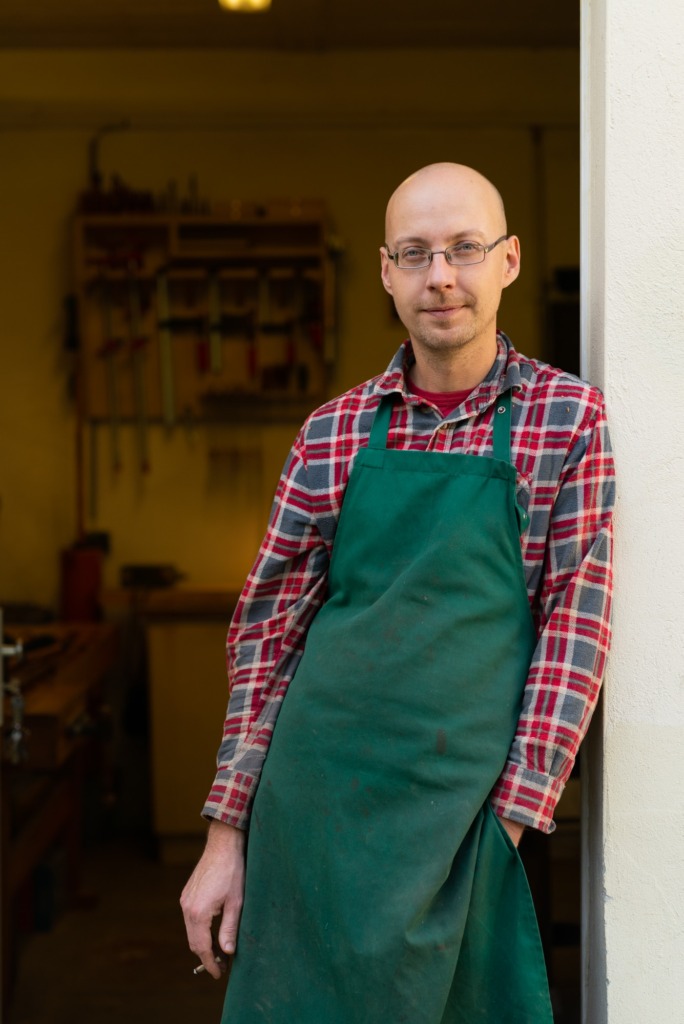
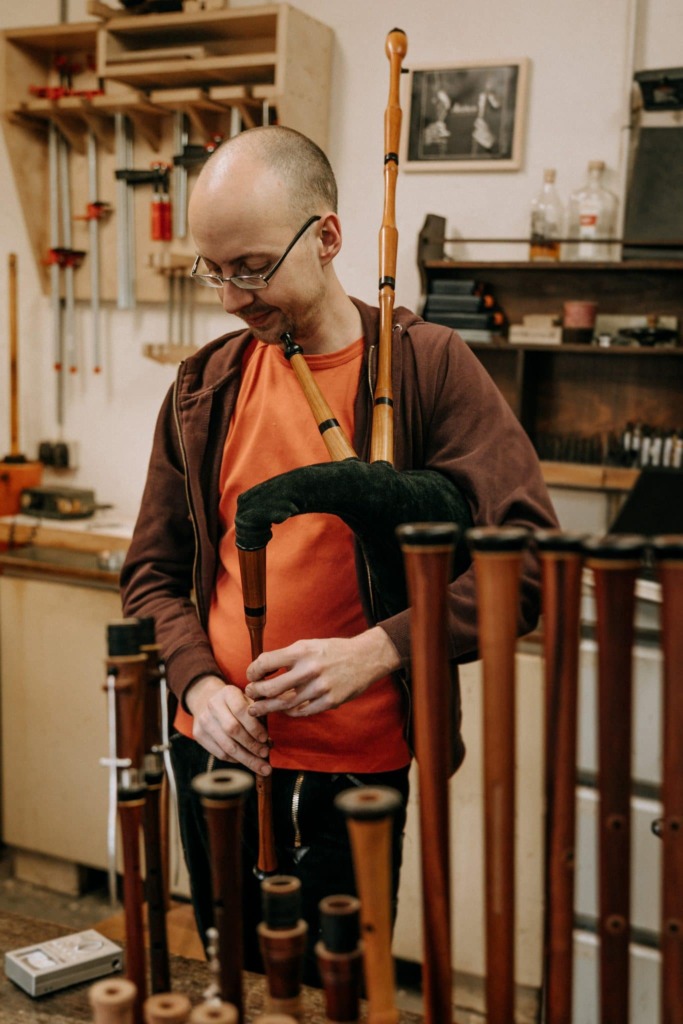
Matthias Branschke is an instrument maker from Berlin. His range includes bagpipes based on French and Swedish models. Matthias is also a professional musician and lecturer at bagpipe workshops.
In his guest article for Folk.World, Matthias gives valuable tips for bagpipe beginners and aspiring bagpipe players.
Matthias Branschke, what is your motivation as an instrument maker?
I started playing the bagpipes at the end of the 90s at the age of 12. Due to the folk revival in the 1970s, the bagpipe repertoire at that time was mainly French-inspired. I was lucky enough to have lessons with Ralf Gehler, who was one of the first bagpipers in Germany to explore our German tradition. He awakened in me the desire to rediscover this tradition and to allow my own creativity to flow into it. To this day, I mainly play new melodies by colleagues and myself, as well as traditional repertoire from the German-speaking world.
And I became a bagpipe maker because I still see a lot of potential in the bagpipes, which you first have to tease out of them.
Which bagpipes do you make?
I make two different types of bagpipes.
On the one hand, there are instruments with conically drilled chanter pipes and semi-closed fingering. These have a fairly wide range for a bagpipe, namely one and a half octaves, and are almost fully chromatic. I make these instruments in three different designs, namely
as a school instrument where the instrument is reduced to the essentials (a drone, blowpipe, chanter, bag and that’s it)
as a shepherd’s pipe, a historical design from the German-speaking world
and as a three-board instrument in which I install all the extras that seem useful to me as a musician on stage. The model runs under the name “Sessionprotz”.
I also make Swedish Säckpipor (plural of “Säckpipa”), an instrument with a cylindrical chanter bore and a reed in the chanter. You can “only” play one octave on it, but I find the Säckpipa particularly suitable for traditional playing.
How do I become a bagpiper?
If someone wants to get into the world of bagpipes, I recommend one thing above all: talking to people who already play. Course weekends are a good opportunity to do this, and there are a lot of them regularly throughout Germany. The world of bagpipes is incredibly diverse.
So if you still have no idea which of the 180 different types (!) of bagpipes you would like to play, I recommend that you attend a beginners’ course. In my opinion, the most flexible instruments for beginners are chanter pipes with semi-closed “French” fingering. Starting with such an instrument opens doors. You can always change over when you know exactly where you want to go.
If you want to play the bagpipes, you need one thing above all: patience. In principle, playing the bagpipes requires the same skills as any other instrument. You have to practise, and every now and then someone should check to make sure you’re not making mistakes.
Unfortunately, the density of bagpipe teachers is nowhere near as good as for classical instruments. However, there are quite a few courses, and lessons via Skype are now also a good alternative. Then it’s just a case of practicing, practicing, practicing.
Don’t get frustrated, no master has fallen from the sky yet, and with 20 minutes of practice a day you’ll make quick progress.
How much does it cost to play the bagpipes?
I think anything under 500 euros for a new instrument is probably a waste of money. There are some manufacturers who offer instruments in this price segment, but most of them are “Made in Pakistan” (no joke) and simply don’t work. It really starts at 1000 euros, but of course there is always room for improvement. It is best to get advice from an instrument maker or someone who has been playing bagpipes for a long time.
What you should spend on lessons and courses depends on how much input you need. If you have the chance to visit a teacher from your region, you should take the opportunity. It usually starts at around 30 euros per hour. Courses – which should not be underestimated as a social event – usually cost upwards of 150 euros for a weekend.
Which textbook would you recommend?
There are only a few textbooks for the bagpipes on the market. Technically good, although actually designed for a French style of playing and therefore highly recommended, is “Dudelsack spielen” by Bernard Boulanger. If you want to broaden your technical knowledge a little, you can find some books for Scottish bagpipes and other “insular” bagpipe types in the English-speaking world, but apart from Boulanger’s book, there are no other textbooks for the bagpipe types that I play.
Do the bagpipes come from traditional music?
The bagpipes were the instrument of traditional music in almost all of Europe until the 18th century. The disco music of the time was played on them, so to speak. Of course, people have always wanted to dance, and a bagpipe can play well acoustically on its own, so you can keep the costs down at a dance evening, only need one musician and the party can start. The bagpipes are therefore inextricably linked with traditional music.
Is there sheet music for traditional bagpipe music?
All the sources of traditional music have been written down by fiddlers. Therefore, the pieces often do not fit directly on the bagpipes. With a bit of skill, many tunes can be adapted. If you want to embark on the journey, I can definitely recommend a bit of music theory. A group of people with whom I am quite good friends have studied the subject intensively. If you want to take a look: Dance music archive
What would you like to pass on to us?
Go for it! If you’re interested in the bagpipes, you should give them a try and check out the instrument at . The world of the bagpipes is incredibly fascinating and diverse, so it’s definitely worth a musical journey .
The saz is one of the most culturally significant musical instruments. Outwardly, it resembles the guitar, but the bulbous body has its very own history, present and future. Perhaps you have already heard of this special instrument, or even had it in your hand? Either way, young Petra Nachtmanova’s journey can inspire you! Her experiences can be seen on the TV channel “arte” under the title “Saz – from Berlin to Khorassan”.
With the saz to Iran
Petra Nachtmanova has undertaken an extraordinary journey on the trail of this fascinating folk instrument. Her discovery tour begins in Berlin, from where her journey takes her far to the south-east. It soon becomes clear how widespread the instrument is. She quickly finds other saz players and delighted listeners who know and appreciate the sound of the folk instrument. It is a journey that also raises the question of her own identity. Where do you find your place in life? Does the culture in whose footsteps you follow have to be your heritage? The answer is complex.
The melancholy melodies are your companions as you follow Petra to the origins of this folk instrument. Together with her sound engineer, she first sets off for Bosnia, the westernmost country where this stringed instrument is traditionally played. From there she heads to Istanbul. The city is not only the most important hub for saz musicians, but also home to a number of people for whom the saz was an instrument of political resistance. The journey continues to Anatolia. The sad songs of the local culture are in direct contrast to the melancholy but joyful melodies that Petra experiences in Azerbaijan.
Saz musicians are almost like folk heroes there. Their journey ends in Khorasan in Iran, the country of origin of this folk instrument. Here, saz music takes place in a small circle. The melodies are rhythmic and yet appealing, they speak of conviviality and the omnipresent melancholy that accompanies the sound of this folk instrument. Wherever Petra’s journey takes her, she meets people whose lives have been and continue to be determined by the instrument. The people who play the instrument are as diverse as the instrument itself. Some play in groups, others retreat to the mountains to devote themselves to their music, many are thoughtful people.
Experience the moving sound
The saz has a special sound. Each region gives it its own shape and timbre, but it always remains a saz. Petra Nachtmanova proves this, perhaps unconsciously, by trying to find her way into the rhythm of the region with her own saz at all her stops. She succeeds in integrating herself into the local song repertoire. Even if this folk instrument looks a little different in every region and is accompanied by different legends, it remains the same at its core. Saz players seem to be connected across cultures through their instrument.
“The saz doesn’t belong in the big city,” Petra realizes on her journey. This folk instrument is made for melodies that originate in the mountains, and yet it also speaks to city dwellers. Melancholy, but by no means hopelessness, is expressed in the traditional songs. Rather, they speak of a down-to-earth attitude and a connection to nature that has been forgotten but never completely lost. Perhaps you would like to start your own journey of discovery into the world of this special folk instrument?
Imagine a Scottish landscape with green hills and a real Scotsman standing on one of them. He’s wearing a plaid kilt and a hat—just as he should. Most important, however, is the object he’s holding in his arms. This somewhat strange-looking instrument is called a bagpipe, and every child associates it with Scotland.
But all over the world, it goes by different names: sackpipe, bockpipe, Great Highland Pipe, gaida, bock, sackpfiff, schaleika, säckpipa, or cabrette, to name just a few. Every region has its own story about the bagpipes. What do we actually know about this peculiar woodwind instrument, other than that it immediately makes us think of Scotland? Where do bagpipes really come from, how is a note produced, and how does one become a bagpiper?
Origin of the bagpipe – really in Scotland?
Greek shepherd plays the Gaida (Source: Mediawiki)
The word “bagpipes” is derived from the Turkish word “duduk,” which means “flute.” Contrary to what many people believe, the bagpipes did not actually originate in Scotland, but likely in Asia. This cannot be said with certainty, as the oldest historical sources usually leave much room for interpretation. The world’s first bagpipes, it is believed, consisted of a simple reed flute and were found in ancient Egypt and early Mesopotamia. It is unclear when the air bag was added to the instrument.
A Hittite relief from Alaca Höyük in the Turkish province of Çorum, dating back to antiquity, depicts a bagpipe—complete with a bellows—for the first time. Dating from before 1200 B.C., it is likely the oldest known depiction of the instrument. Other reliefs and literary works also suggest that the bagpipe originated in Asia. While the instrument was already found throughout the Mediterranean region in antiquity, the Romans spread it throughout Europe. In many European countries, the bagpipe remains an integral part of the culture to this day. It exerted a strong influence on music, primarily in regions with Celtic influences. This is especially true in Scotland, where the bagpipes were even designated the national instrument.
There is one main reason why this instrument—which takes some getting used to—has endured throughout Scottish history. After the Battle of Culloden, wearing the Scottish kilt and practicing many Scottish customs were banned. However, the Scots were still able to play the bagpipes, which allowed them to identify with at least one aspect of their national identity. Today, the whole world knows the Scottish bagpipes—or the “Great Highland Bagpipe”—thanks to British military music.
The bagpipe is a continuous-sound aerophone, or a reed instrument. To play it, the air bag must first be filled with air. This can be done in various ways, such as using a bellows or a mouthpiece. If the piper uses a bellows, he can even sing while playing.
A check valve prevents the air from flowing back. To produce notes, the player compresses the bellows with their arms or body, creating a steady air pressure. One or more drone pipes—usually located at the top of the bellows and often resting on the player’s shoulder—therefore produce a constant, sustained tone. This drone, which sounds like a pedal note throughout the performance, is characteristic of the Bockpfeife’s unique sound.
Functionality
Scheme of Scottish Highland bagpipe
The bagpipes’ well-known polyphony is achieved through the melody. This is played on a chanter, just as on a regular flute. The six to eight finger holes on the chanter determine the pitch. To add accents and distinguish the notes of a melody from one another, the player must play numerous grace notes, similar to tied notes. This requires concentration and coordination, as the fingers must be placed at precisely the right moments.
The continuous tone is produced by a single reed in the drone pipes—made of reed, plastic, or metal—which is set into vibration by the airflow. The chanter usually contains a double reed. Such a reed can be compared to that of an oboe. The air bag used to be made of leather, but today it is often made of synthetic material. Many players opt for a decorative cover for their Scottish bagpipes.
The unique musical characteristic—and the challenge—of playing the bagpipes is that the playable keys are limited on many types of bagpipes. Chromatic notes are also often unplayable. Since most bagpipes are tuned diatonically, notes outside the key can only be played to a limited extent. This is one of the reasons why playing the bagpipes requires a high level of skill. In addition, the player must have a large lung capacity. Therefore, beginners are advised not to buy a bagpipe right away, but to take lessons at a music school first. There, students can practice on a training bagpipe.
Types and distribution of bagpipes
[youtube https:=””] A little more than a millennium after the Roman Empire, numerous regional types of bagpipes emerged during the Late Baroque period. They varied depending on the location, era, and the maker’s taste. Today, there are approximately 180 different types of bagpipes throughout Europe. Adapted to modern times, there are even electric bagpipes that can be connected to a computer or amplifier via MIDI.
But let’s first return to the Middle Ages and the early modern period. There, the bagpipes flourished as a folk and shepherds’ instrument and were an indispensable part of the musical landscape. Later, during the Baroque period, the regional variations of the bagpipe gave rise to the Musette de Cour in France, which became the best-known instrument of its kind. Other notable types that emerged from this development include the Bohemian Bock, the Zampogna from Italy, and the Gaida from Bulgaria.
In Central Europe, replicas of historical instruments are still being built today to recreate medieval music. The bagpipes also have a long tradition in Northern and Northeastern Europe, Austria, Southern Germany, India, and Iran. In India in particular—which is believed to be the instrument’s country of origin—playing the so-called “mashak” or “titti” is a cultural custom at weddings. Unfortunately, even in India, these two types of bagpipes have been overshadowed by the Great Highland Bagpipe from Scotland.
A Look at Four Types of Bagpipes
At least 45 regions around the world are known to have their own distinct types of bagpipes. To get a sense of the diversity of bagpipes, we’ll focus on just two of the better-known types from Scotland and Central Europe.
Scottish classic – the Great Higland Bagpipe
[youtube https:=””] The Great Highland Bagpipe is probably the best-known type of bagpipe. It immediately brings to mind Scottish landscapes and men wearing traditional Scottish Highland attire. Originally, it was a popular folk instrument, but from the 19th century onward, it became primarily associated with military music. Starting in the 1980s, the Great Highland Bagpipe—usually made of grenadilla wood—also gained prominence in Germany. Scottish bands and groups were formed, some of which still exist today. The Great Highland Bagpipe consists of two tenor drones, one bass drone, and a chanter with nine notes. Although the bagpipe is tuned to B-flat, most of the music is traditionally notated in A, so the player must transpose. The bagpipes therefore sound a semitone higher than what is written.
The little sister – the Scottish Smallpipe
[youtube https:=””] If you’re looking to switch from the louder Great Highland Bagpipe to a quieter version, the Scottish Smallpipe is a great choice. Thanks to its soft and warm sound, it’s ideal for playing indoors. It also shines when played alongside other instruments. Its versatility is evident not only in the fact that it can be played both by mouth and with a bellows, but also in its tuning. Various fundamental pitches from A to D are possible. Switching from a Great Highland Pipe to a Scottish Smallpipe is straightforward, as the fingering and ornamentation techniques are the same.
Wide range – the shepherd’s pipe
[youtube https:=””] The shepherd’s pipe is a traditional German folk instrument used primarily for dance music. It is slightly louder than the Scottish smallpipe, but still has only a moderate volume. Modern construction is based on the Flemish bagpipe. Since some notes can be overblown, the instrument has a wide range in which almost all semitones can be played. In addition, like the Flemish bagpipe, the shepherd’s pipe offers good stability and the wide range mentioned above. The shepherd’s pipe is often played alongside Drehleier, violins, or other folk instruments.
The French Cabrette
[youtube https:=””] From the late 19th century to the early 20th century, the cabrette made its way to Paris. At dance events there, it was usually played alongside an accordion. This type of bagpipe consists solely of a bellows and a chanter, which is connected to a single drone pipe. In some cases, decorative drones are even attached, though they serve no functional purpose. Initially, the cabrette was a mouth-blown instrument; later, it was equipped with a bellows. This is said to be the work of the carpenter Joseph Faure. He was the first to use a bellows because he suffered from a lung disease.
Related instruments
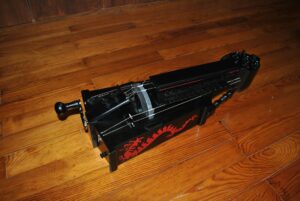
a hurdy-gurdy as an example of a related drone instrument
The sound of the bagpipes is probably unlike that of any other instrument. However, the way sound is produced—or the playing technique—is not unique. We are familiar with playing using a bellows, for example, from the organ and the accordion. Instead of an air sac, the Platerspiel uses an animal bladder as an air reservoir. Other drone instruments include the hurdy-gurdy, the drone zither, and double flutes. The crumhorn and the rauschpfeife are also wind-chamber instruments.
The bagpipe – a versatile and distinctive instrument
[youtube https:=””] After the instrument fell out of use in Germany in the 19th century, it has experienced a revival in recent decades. No wonder, given what a wonderful instrument it is. Whether played solo or together with other instruments, it sounds fabulous. Its sounds transport us to the world of the Scots and make us dream of green, rolling hills. But now we also know where the bagpipes truly originated.
The bagpipe is an instrument worth learning for its characteristic polyphony, because not everyone can play the bagpipes.
As promised, starting today you can read the second part of the interview with Jutta Weber-Kran here. She maintains the website Folkloretanznoten.de with a lot of love, time, and dedication. Enjoy! Continue reading An incredible fund of dance music – Part II
In January 2016, the Folkloretanznoten.de website underwent a visual redesign. This online sheet music collection has been available for over 15 years and now features more than 2,500 dance pieces from the Balkans, Europe, and other parts of the world. We spoke with Jutta Weber-Karn, who is now in charge of managing folkloretanznoten.de. Continue reading An incredible fund of dance music – Part I
Murra Lala Fafal is a successful singer from a rural family of the Marwada Meghwals, who have traditionally been singers for 11 generations. In the Kutch region, as in many other regions of India, it is a living tradition for children to be taught to sing by older family members. Murra Lala began his musical training by playing the manjiras (hand cymbals) and singing.
Murra Lala Fafal has been singing his whole life. His joyful spirit, his musical wit, and his gift for finding the right song for every occasion make him one of a kind. The musicians accompanying Murra Lala play instruments such as the santaar (stringed instrument), ghada ghamela (drum with a metal bowl), jodiya pava (a regional double flute), and manjiras. Together, they express the essence of the people’s cheerful spirit. They create dynamic compositions while Murra sings with his characteristic, strong, high-pitched voice.
With perfection, pompous yet artistic, and traditional folk dances – this is how the French present themselves in Lorient in Brittany.
With loading the content you agree to the privacy policy of YouTube.
The “Bagad Sonerien An Oriant” from Lorient, or “Bagad de Lorient” for short, plays on the open street. Among others, Stéphane Kermabon can be seen and heard leading this musical bagpipe ensemble with the Binioù kozh. This is followed by the first Binioù Braz, or Great Highland Bagpipes. The bombarde players contribute clear accents and punctual melodies. The beat is led by a team of Scottish snare drum players. Incidentally, Yann Kermabon can also be seen playing the bombarde in the first video.
Some of the dances are rehearsed and originate from traditional Breton folk dances.
But how do such gatherings come about? In France, this type of band from the video is called“Bagad“. Bagad, in turn, is the Breton word for group.
Bombarde, Great Highland Bagpipe, Scottish snare drum
A bagad is an ensemble of traditional Breton musicians, inspired by Scottish pipe bands. It consists of three sections: bombarde players, biniou braz players (Great Highland Bagpipe), and percussionists. Depending on the size of the bagad, the percussion section may be divided into two subgroups: one consisting of traditional drums (Scottish snare, drum set) and the other consisting of non-traditional percussion instruments.
Since the early 1990s, the skills of many Bagadou (= plural of Bagad) in France have developed to a high level, leading to the Pipe Band World Championships, which take place every year in Glasgow, Scotland.
Bagad Mouez Ar Mor (Author: Larvor, Source: wikimedia.org, License: CC BY-SA 3.0)
A bagad is conducted by the Penn-Soner (literally “chief bell ringer” in Breton). The three sub-groups for bagpipes, bombarde and percussion are each led by a “tuner”, who sometimes practise with the participants separately from the other groups.
The Bagadou play Breton melodies, including Breton dance tunes.
They were inspired by the pipe bands, which are typically made up of Scottish bagpipe players and percussionists. The Bagadou also have bombardes. They give the ensemble a great variety of sounds, such as question-and-answer games and other refinements. The much less military style clearly distinguishes the Bagadou from their pipe band role models.
This second video is also very beautiful. It ostensibly shows dancers accompanied by the Bagad de Lann-Bihoué.
With loading the content you agree to the privacy policy of YouTube.
The question of whether bagadou can actually be considered traditional Breton music is often debated, as the first formations were only formed during the Second World War, which makes them hardly comparable with the age of the Breton tradition. However, it cannot be denied that the Bagadou movement is clearly revitalizing Breton culture and, above all, Breton music through the integration of Breton dances and costumes and through its great popularity with young people and the general public. The Bagad ensambles in France are characterized by vitality and openness.
Every major region and town in Brittany has its own Bagad. There are over 80 groups in total. This does not include the Bagadou outside Brittany. The military also has its own bagadou, the best known of which belongs to the French Navy and is called Bagad Lann Bihoue.
Today, the public program of the well-known Bagad groups is mainly determined by festival appearances (such as at the Festival de Lorient), their own concerts and welcome concerts during state visits.
Um diesen Inhalt zu sehen, musst du erst die Cookies akzeptieren.
This last video shows the Bagad de Lorient again, but without the dances and this time as an independent concert. The three instrument groups of bagpipes, bombarde and percussion can be seen here once again. It’s nice to see some of the participants changing instruments frequently.