Posted on — Leave a comment

Handpan Perfection: “Live @ HUG’20 Festival” by Nadishana & Peter Somos

Hardly anyone plays the hang as versatile as Nadishana. Miraculously, he and Peter Somos were able to perform at the HUG Festival in Hungary in the summer of 2020, despite the pandemic. For Nadishana, this is a gift, which is why he wants to share the recording with the world on his new album, “Live @ HUG’20 Festival.” Folk.World listened to the album for a Folk Review.

An endless expanse. The grass of the steppe sways in the wind. In the distance, tall mountains with snow-capped peaks. A brass instrument plays in the background. It sounds percussive and melodious, familiar and exotic, a little ghostly, but also very alive. You run toward the distant mountains. A Siberian steppe fox crosses your path. It stops and looks at you. It knows everything about life, death, and the universe.

From Siberia to Berlin (and on to Transdanubia)

Nadishana believes that music should be a combination of mystical beauty, mastery, innovation, good taste, knowledge, and a message of great depth. The musician is humble enough to add that his compositions will likely never live up to this ideal. Still, he seems to feel it is necessary to keep this goal in mind.

Nadishana was born in a small town in southern Siberia. While studying in Saint Petersburg, he taught himself to play the guitar. Today, the musician has mastered an impressive number of instruments, ranging from the bawu to the kalyuka to the zhaleyka. In recent years, he has focused on playing the handpan. The multi-instrumentalist has lived in Berlin since 2005. He has recorded 12 albums and collaborates with numerous musicians from all over the world. One of these musicians is Peter Somos. The Hungarian musician also plays several instruments: mainly drums, but also keyboards, bass, and all kinds of percussion. On the album “Live @ HUG’20 Festival,” he plays various percussion instruments while playing bass notes on the keyboard with his left hand.

Album "Live @ Hug Festival" by Nadishana and Peter Somos
Album “Live @ Hug Festival” by Nadishana and Peter Somos on Amazon.de

The “20” in “Live @ HUG’20 Festival” actually stands for the year 2020! And so, in August of this year, we’ll be heading to Csesznek in Transdanubia, Hungary, with Nadishana and Peter Somos.

HUG stands for “Hungarian Handpan & World Music Gathering.”

This small festival takes place over three days in the summer at the foot of Csesznek Castle. The focus is on music made with the handpan, but the festival is open to all kinds of folk and world music. While concerts take place in the evening, during the day you can attend workshops to learn how to play various instruments. Among these instruments, of course, is the handpan.

It seems almost strange that the HUG didn’t fall victim to the virus. The reason is that Hungary had hardly been affected by COVID-19 until the end of August. For Nadishana, it was the only concert this year. He explained to Folk.World in an interview that the recording is a precious memory for him and a ray of hope in a bleak situation. For this reason, the decision was made to release the recording as “Live @ HUG’20 Festival.”

A handpan—what is it?

A handpan is a metal percussion instrument played with the hands. The instrument consists of two hemispheres. The sound fields are located on the top surface, and there is an opening on the bottom. The sound fields are curved inward and produce different notes. Only the field at the highest point of the dome curves outward. This field produces the lowest note.

On “Live @ HUG’20 Festival,” Nadishana uses three double-sided handpans. In addition to the Folk Review, we have a Folk.World interview on our site in which the musician talks about his instruments. He also told us what music inspires him, what he thinks about the pandemic, and how the album “Live @ HUG’20 Festival” with Peter Somos came about.

“Live @ HUG’20 Festival”—listen and watch

The purely instrumental music on “Live @ HUG’20 Festival” has a relaxed feel. I’d call it world music. It’s a real pleasure to watch the musicians play. They play with precision, virtuosity, and great seriousness. At times, they seem so deeply immersed in their music that they’ve forgotten they’re at a festival. In addition to folk and trance, I hear fusion in particular. The first track on “Live @ HUG’20 Festival” reminded me of Chick Corea’s “Return to Forever.” After that, everything sounds a bit edgier. Later on, the music recedes into the background, and “ambient” would be a fitting description. Ultimately, though, the Siberian steppe fox always looks deep into your eyes.


Further contributions:

    Posted on — Leave a comment

    “Snow White and the Seventh Dwarf” by Patatras! – a musical journey

    It begins with a violin and an accordion playing in a café on the left bank of the Seine in Paris. English-speaking tourists are sitting at a table drinking German beer. Someone laughs loudly. A high note from the violin flies through the room. The (arrogant) French waiter raises an eyebrow.

    Folk.World takes this scene as an opportunity for a folk review of the album “Snow White and the Seventh Dwarf” by Patatras.

    Images in your head

    If the play “Joli Coeur” makes you think of Paris, “Snow White and the Seventh Dwarf” soon takes you to the rugged coasts of Asturias. A little later, you are standing at the fence of Villa Kunterbunt in Sweden. Afterwards, you see yourself with teary eyes wandering across Ireland’s green meadows to Turlough OʼCarolan’s “Fanny Power”. The sheep turn their heads to you in amazement. You are now in Münsterland at a farmer’s wedding. And you are spinning in circles to the sound of violin and accordion. You are dancing!

    Album "Snow White and the Seventh Dwarf" by Patatras!
    Album “Snow White and the Seventh Dwarf” by Patatras on Amazon.de

    To avoid any misunderstandings, “Snow White and the Seventh Dwarf” is not a concept album. The musicians do not want to take you on a musical journey through the most beautiful regions of Europe. They have not chosen the pieces for this purpose. The selection on “Snow White and the Seventh Dwarf” is due to the broad interest and enjoyment of the music. The images arise in your head because the music provides the space for them. The allusions to certain places or times are often not so clear. Your images will look different from mine. And then it also depends on whether you read the names of the pieces while listening.

    Humming and beeping

    “Snow White and the Seventh Dwarf” contains only instrumental music. These are traditional dances, many of which can be found in the Dahlhoff collection from the second half of the 18th century. Then there is Turlough OʼCarolan’s “Fanny Power”, which has already been mentioned. There is also the modern tradition of Christoph Pelgen and Cyril OʼDonoghue, as well as a piece by Dagmar Scholz. It gets funny when the “Long Socks Minuet” transitions into the melody to Pipi Longstocking. The combination of Christoph Pelgen’s “Winter Waltz” and the folk song “Wenn ich ein Vöglein wär” works brilliantly.

    The album “Snow White and the Seventh Dwarf” is fun to discover. You can listen to the album again and again and follow the melodies of the violin and accordion. The melodies overlap, entwine around each other, sometimes one precedes the other. Suddenly there is a rhythm underneath everything, which soon disappears and then returns. The arrangements on “Snow White and the Seventh Dwarf” are independent and sophisticated.

    Patatras gives the impression of a chamber orchestra, but you only hear violin and accordion. The musicians recorded most of the pieces live in the studio and made do with just a few overdubs. Despite the wide range of musical influences, the album comes across as a unified whole. And what is even more important to me personally is that the music doesn’t sound clinical at any point. It squeaks and squeaks. It hums. It rubs.

    Two from the music school

    A folk review on Folk.World includes some biographical information. The duo consists of Barbara Kranz and Steffi Budde. They told Folk.World in an interview that they met 35 years ago at the music school where they now teach. They played together in the folk rock band Celtic Brew and joined Dancing Willow after it broke up. The duo Patatras has existed since 2017 and now their debut album is out.

    On the stage

    Folk.World would like to experience “Snow White and the Seventh Dwarf” in concert after listening to the CD so that we can report on the performance in another Folk Review afterwards. It’s worth it because the musicians have a lot to say between the songs. The announcement for the piece “Snow White and the Seventh Dwarf” should be interesting. Like everyone else, Folk.World will have to wait a little longer.

    Until then, I’ll tell you my version of how the duo got their name: The (arrogant) French waiter in the café on the left bank of the Seine hadn’t raised an eyebrow at the sound of the fiddling violin. He slowly turned his head and shouted loudly: “Patatras!”


    Further contributions:

      Posted on — Leave a comment

      “Stormweere” from Spilar: Flemish tradition alive

      Mandolin, mandola, guitars—on the debut album “Stormweere” by the Belgian band Spilar, everything seems to float. The sounds fly through the room, while a voice sings very close to your ear. You hear a strange language. It seems familiar, yet you can’t quite understand it. In this review, Folk.World tells you about Flanders, Christ, and raids.

      Bruges in the afternoon

      As the afternoon progresses, most of the tourists leave the city and Bruges becomes quiet. There is no one who wants to climb the Belfry. There are no boats on the canals. The streets have emptied. It seems like a good time to track down the ghost of these ancient walls. Is there a disembodied shadow fleeing across the cobblestones? Has the curtain behind the window moved? Spilar play the soundtrack to this film: crystal clear, rich in detail and skillful. The musicians have set out in search of the past of their home region.

      From Snaarmaarwaar to Spilar

      Spilar emerged from a project by the power folk trio Snaarmaarwaar. The trio had added several musicians for an anniversary tour and played a series of Flemish songs. They all took great pleasure in rearranging the old music. So they came up with the idea of a second band consisting of the trio, a singer and a drummer. In their search for suitable songs, the musicians became more and more interested in the traditional music of Flanders. The album “Stormweere” is the result of this work.

      West Flemish

      The musicians sing most of their songs in the West Flemish dialect. West Flemish is the language of a minority in France and the Netherlands. In West Flanders, it is used by a majority as a colloquial language. Despite all the differences, West Flemish is quite similar to Dutch. In some places, you might think you understand what is being sung in “Stormweere”. However, this can lead to misunderstandings.

      Album "Stormweere" by Spilar
      Album “Stormweere” by Spilar on Amazon.de

      Most of the songs on “Stormweere” have a traditional background. There is the folk classic “Roosendaal”: three crooks commit a robbery. Afterwards, they celebrate a wild party in Antwerp with the stolen money, which ends a day later on the gallows. Other songs come from the Christian tradition (“Suver Maecht”, “Sterre”). Then there is the dark Jacques Brel chanson: “Pourquoi faut-il que les hommes s’ennuient”. The musicians have translated the text into West Flemish. They play it as a “Pertank” in a wonderfully windswept version. Almost at the end comes the touching “Verdronken Land”. Wannes Van de Velde wrote this song about the salt marsh landscape of Saeftinghe.

      Too beautiful?

      “Stormweere” was produced by the band’s guitarist Jerome Geerinck. And the sound is flawless. Mandolin, mandola and guitar have plenty of room to unfold. The vocals sound intimate. Synthesizers play simple tone sequences. In some of the songs you can hear driving drums. I listened to the album for the first time while running in the park. The music lifted me off the ground a little. Spherical might be the right word. Under headphones, “Stormweere” is an audiophile experience.

      You might even find it a little too beautiful. I wouldn’t really recommend this album to someone who likes gritty rock ’n’ roll. But that’s not the problem. The question is rather whether this production offers a gateway to traditional Flemish music. The album sounds as if you’re viewing tradition through a glass case. It’s a stroll through a deserted Bruges. On Breidelstraat, you see only the shadows of times gone by. It doesn’t seem to me that the musicians want to immerse themselves in the tradition. Rather, the band is exploring the past. This detached approach is, of course, perfectly valid. The Criticism So it kind of falls flat. Still, I miss the smells: perfume, blood, and dirt.

      “Stormweere” in concert

      It should be exciting when Spilar bring their album to the stage. Anyone who has seen a performance by the band Snaarmaarwaar knows that the musicians deviate considerably from the studio version of their songs. Will this also apply to Spilar? Will the distance fall? You can find out. A few dates in Belgium are coming up from the end of August. Folk.World is in a positive mood.


      Further contributions:

        Posted on — Leave a comment

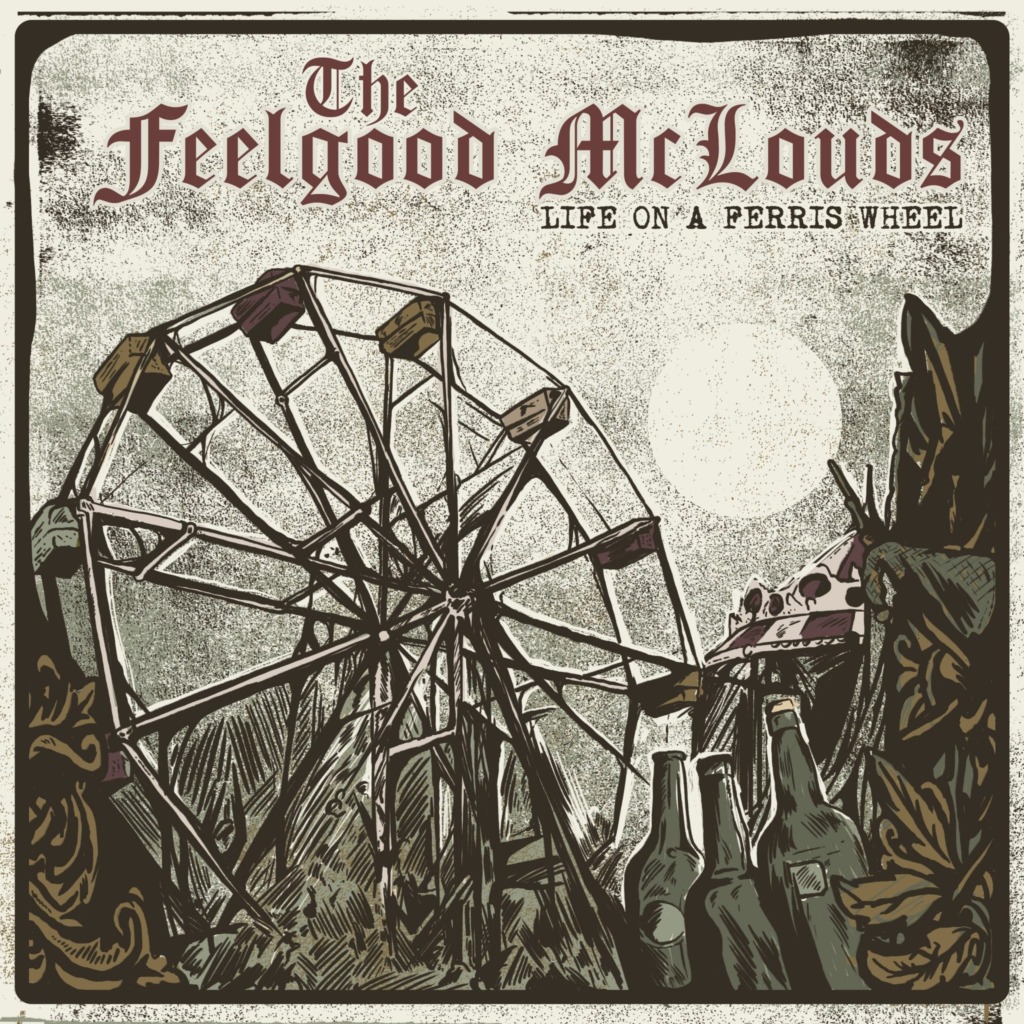
        “Life on a Ferris Wheel” by The Feelgood McLouds rocks!

        Imagine entering a run-down music bar. There is a big crowd. It’s incredibly loud. The floor is sticky with spilled liquid. Waiters are balancing trays through the crowd. Beer sloshes in the glasses on the tables. There is a band on the small stage with too many people playing for there to be enough room for everyone. The bass player hits the singer in the head with the mechanics. The banjo player knocks over the drummer’s cymbal stand. The atmosphere is exuberant. Suddenly the whole room is screaming. What’s happened? Everything’s fine – they’re just singing. That’s the chorus.

        This is what it would normally have looked like when The Feelgood McLouds release their new album “Life on a Ferris Wheel” on May 8th on Wolverine Records. For now, the virus is throwing a spanner in the works. The poorly rinsed glasses of this music pub would be a serious danger. Fortunately, we are allowed to pop a silver disk into the CD player. There’s a cold beer in the fridge. And off we go with the album review.

        Six New Dubliners

        The Feelgood McLouds play Celtic punk. The six Saarlanders describe themselves as a younger version of the Dubliners, if they were influenced by punk. However, the musicians insist that they are more hard-drinking than the Dubliners. After their debut in 2017, “Life on a Ferris Wheel” is the band’s second album.

        Album "Life on a Ferris Wheel" by The Feelgood McLouds
        Album “Life on a Ferris Wheel” by The Feelgood McLouds on Amazon.de

        In addition to guitar, bass and drums, banjo, accordion, tin whistle and bagpipes can often be heard. Banjo and accordion were not on the first album. On “Life on a Ferris Wheel”, everything also sounds a little more sophisticated and mature. The range of influences has increased. For example, “Lovers and Friends” is a ska number for long stretches. In “Off the Rails” you can hear a banjo playing a bluegrass theme. With “In our Pup”, there is even an almost quiet song on this album.

        The Feelgood McLouds have expanded their possibilities. They are starting to play with the genre. As a Celtic punk fan, you can still remain relaxed. The energy of punk can always be felt and themes from Celtic folklore are constantly cropping up. There is also a roaring male choir in every song! When listening to “Life on a Ferris Wheel”, you’re bound to think of The Pogues more than once. The Feelgood McLouds have to be measured against the forefathers of the genre. The band’s lyrics are mostly about partying and drinking. Sometimes the musicians also address more serious topics. In “Spineless Mass” they even call for a riot.

        Celtic Saarlanders

        When musicians play a genre that is associated with a specific place or landscape, the question arises as to where these musicians come from. Can someone who grew up in the Saarland deal with the traditions of Irish and Scottish folklore?

        The question of authenticity is justified, but it seems a little academic to me. We wouldn’t reject a country singer from New York because he wasn’t born in the Appalachians. We wouldn’t deny a Japanese violinist a feeling for Viennese classical music.

        First and foremost, I can hear the joy of music in The Feelgood McLouds. What the musicians deliver on “Life on a Ferris Wheel” is genuine. They write their songs themselves. They hammer away on their instruments. They sweat. They grin. I wouldn’t mind if alphorns were used on the next album. Maybe a mariachi trumpet would be even better. The band could do something really crazy and sing a song in a Saarland dialect.

        Back on stage

        The concert in the run-down music pub described at the beginning will not take place for the time being. But you will have a lot of fun when “Life on a Ferris Wheel” booms out of your speakers. And watch the video for the song “Moonshiners” right after reading the album review. The Feelgood McLouds will return to the stage. The band’s music belongs on stage. Everyone sings along! Then there’s another beer.


        Further reviews: