
Celebrate three days of music, dance, and joy at the 16th KlangRauschTreffen from June 16–18, 2023, and meet many like-minded people, including hurdy-gurdy, bagpipe, and nyckelharpa players. Enjoy concerts, workshops, and the folk song contest, and visit the instrument makers. Register now and join the fun!
3 days full of music, dance and joy
The 16th KlangRauschTreffen will take place from June 16 to 18, 2023, at the Hösseringen Museum Village near Suderburg. The event offers musicians, dancers, and anyone interested a platform to make music, dance, and exchange ideas together.
The open-air museum grounds and the adjacent areas will be used for the festival. There are several dance floors, including one at the Brümmerhof and an open-air stage at Haus Bahnsen. There is also a chill-out tent available.
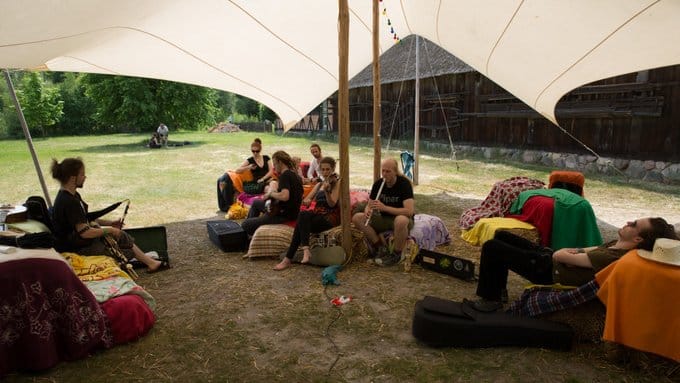
The KlangRauschTreffen offers a varied program featuring sessions, concerts, lectures, and workshops on traditional music and dance. Children are welcome—the grounds are designed to be child-friendly.
When the weather is nice, there’s also an open stage with an outdoor dance floor. Short music and dance workshops are offered during the day.
The ticket office and campgrounds open on Friday, June 16, at 3:00 p.m. The supporting program begins at 7:00 p.m. On Sunday, the gathering concludes with a closing concert around 2:00 p.m. The ticket office, including CD and sheet music sales, will also close at that time.
The KlangRauschTreffen promises three days of music, dance and entertainment in a picturesque museum setting.
Short workshops & lectures
The KlangRauschTreffen offers a variety of short workshops and lectures. The workshops provide a brief introduction to various topics and last about two hours. No advance registration is required, and you can attend as many workshops as you like.
In the music section, there are workshops such as “Doc Grooving” with Doc Rossi, who demonstrates various ways to combine Baroque dance music, traditional dance music, and original compositions. Workshops on singing and playing folk songs together are also offered, including “Unterm Lindenbaum” with Tim Liebert. Other workshops focus on German dance notation, accompaniment, and harmony.
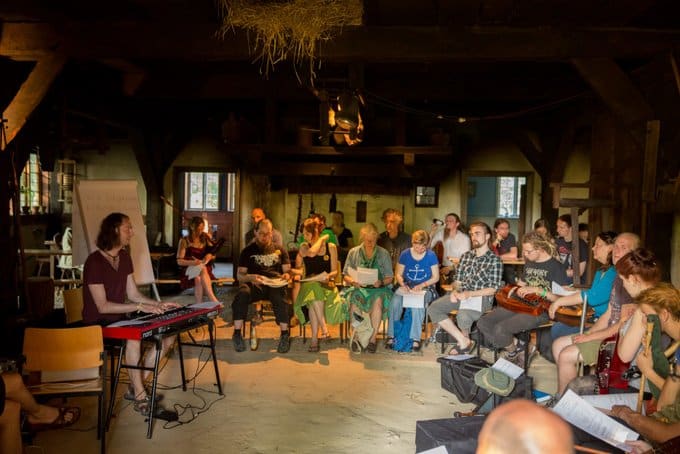
In the area of dance, there are workshops for beginners as well as workshops on specific dance styles such as the Franconian “Zwiefachen” and the Westphalian “Tanzboden.” Dahlhoff sets—traditional dance programs from days gone by—are also performed.
Other activities include repertory marathons, concerts, dances and a graduation matinee.
The detailed program and further information are available in PDF format.
Instrument maker & publisher of minstrels
At the KlangRauschTreffen 2023, various instrument makers will present their instruments. Instrument makers confirmed so far are:
- Matthias Branschke from the Bagpipe Manufacture
- Johanna Isselstein making nyckelharpor.
- Max Brumberg, who makes flutes.
- Jonas Böttcher from the Verlag der Spielleute.
- Moritz Dortmund, which manufactures harps.
- Walther Simons, which manufactures hurdy-gurdies.
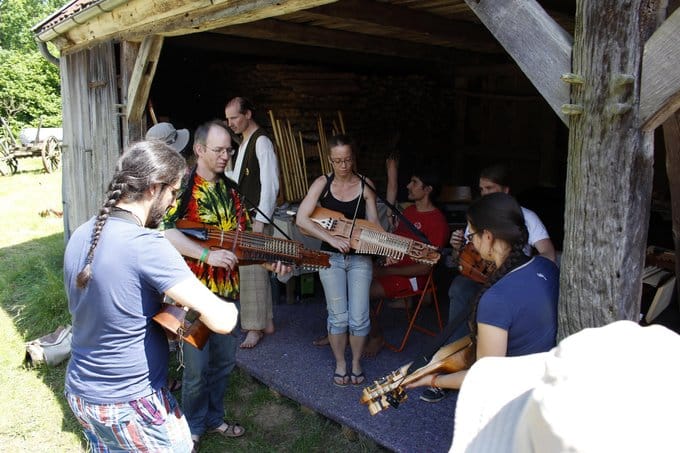
More instrument makers may be added in the future. If you’re interested, you can click on the instrument maker’s photo to visit their website.
Folk Songs Newfound Contest
The KlangRauschTreffen Folk Song Rediscovery Contest, which took place in 2022, will enter its second round due to its great success. The goal of the contest is to showcase new, previously undiscovered folk songs. Although there are many collections of folk songs, the same well-known songs are constantly being rearranged. The competition aims to bring these undiscovered songs to the public’s attention. Participants can perform a newly discovered song solo or with accompaniment and will be judged by an audience jury.
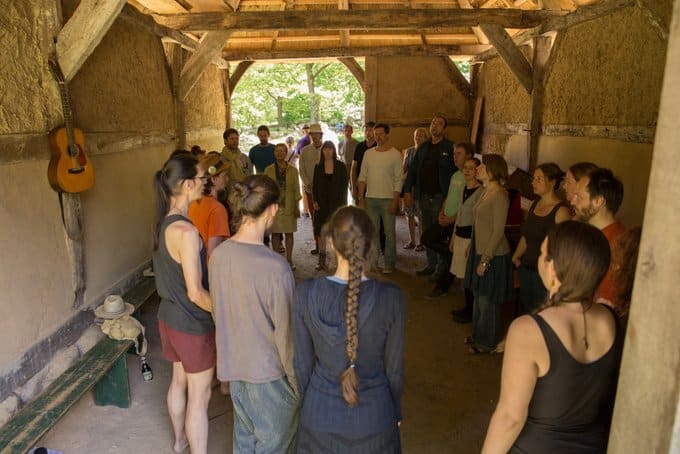
The winner will receive either a €50 gift certificate from deutschtradshop.de or free admission for two people to the 2024 KlangRauschTreffen. Original compositions or musical arrangements are not permitted. The contest will take place on KlangRausch Sunday at 12:30 p.m. at the Brümmerhof, and the winner will be announced during the evening concert. Those interested must register in advance via email and can find inspiration online from various sources. There is also a list of well-known songs that serve as examples. The KlangRausch team—consisting of Matthias Branschke, Vivien Zeller, and Merit Zloch—looks forward to the participants’ entries.
Further contributions:
- PTFE Sealing Tape on a Bagpipe—Here’s How to Wrap a TenonYou’ve just tuned the drone, and already the upper part has slipped down a bit.… Read more: PTFE Sealing Tape on a Bagpipe—Here’s How to Wrap a Tenon
- Step-by-step instructions: How to seal your bagpipe professionallyThere’s nothing better than the sound of a well-played bagpipe, but for that sound to… Read more: Step-by-step instructions: How to seal your bagpipe professionally
- Mastering Bagpipe Music Theory – The Beginner’s Course for All Players! 🎶🎵The Bagpipe Academy offers a high-quality course called “Music Theory for Bagpipers (Basic Course).” This… Read more: Mastering Bagpipe Music Theory – The Beginner’s Course for All Players! 🎶🎵

