Posted on — Leave a comment

16th KlangRauschTreffen (June 16 – 18, 2023)

Celebrate three days of music, dance, and joy at the 16th KlangRauschTreffen from June 16–18, 2023, and meet many like-minded people, including hurdy-gurdy, bagpipe, and nyckelharpa players. Enjoy concerts, workshops, and the folk song contest, and visit the instrument makers. Register now and join the fun!

3 days full of music, dance and joy

The 16th KlangRauschTreffen will take place from June 16 to 18, 2023, at the Hösseringen Museum Village near Suderburg. The event offers musicians, dancers, and anyone interested a platform to make music, dance, and exchange ideas together.

The open-air museum grounds and the adjacent areas will be used for the festival. There are several dance floors, including one at the Brümmerhof and an open-air stage at Haus Bahnsen. There is also a chill-out tent available.
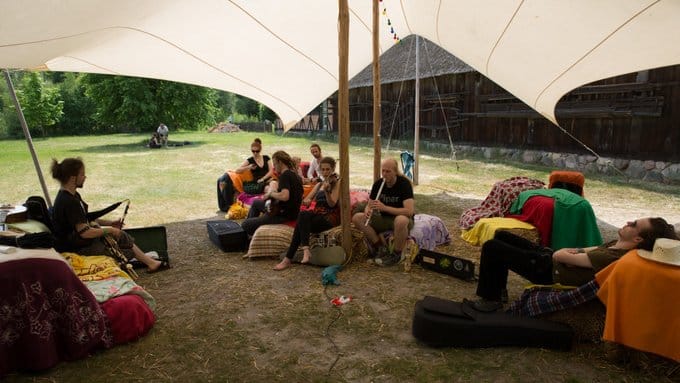
KlangRauschTreffen under the Chill Out tent

The KlangRauschTreffen offers a varied program featuring sessions, concerts, lectures, and workshops on traditional music and dance. Children are welcome—the grounds are designed to be child-friendly.

When the weather is nice, there’s also an open stage with an outdoor dance floor. Short music and dance workshops are offered during the day.

The ticket office and campgrounds open on Friday, June 16, at 3:00 p.m. The supporting program begins at 7:00 p.m. On Sunday, the gathering concludes with a closing concert around 2:00 p.m. The ticket office, including CD and sheet music sales, will also close at that time.

The KlangRauschTreffen promises three days of music, dance and entertainment in a picturesque museum setting.

Short workshops & lectures

The KlangRauschTreffen offers a variety of short workshops and lectures. The workshops provide a brief introduction to various topics and last about two hours. No advance registration is required, and you can attend as many workshops as you like.

In the music section, there are workshops such as “Doc Grooving” with Doc Rossi, who demonstrates various ways to combine Baroque dance music, traditional dance music, and original compositions. Workshops on singing and playing folk songs together are also offered, including “Unterm Lindenbaum” with Tim Liebert. Other workshops focus on German dance notation, accompaniment, and harmony.
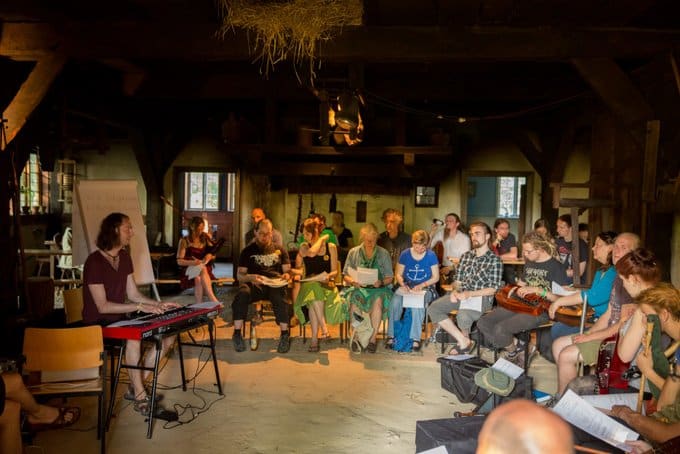
In the area of dance, there are workshops for beginners as well as workshops on specific dance styles such as the Franconian “Zwiefachen” and the Westphalian “Tanzboden.” Dahlhoff sets—traditional dance programs from days gone by—are also performed.

Other activities include repertory marathons, concerts, dances and a graduation matinee.

The detailed program and further information are available in PDF format.

Instrument maker & publisher of minstrels

At the KlangRauschTreffen 2023, various instrument makers will present their instruments. Instrument makers confirmed so far are:

  • Matthias Branschke from the Bagpipe Manufacture
  • Johanna Isselstein making nyckelharpor.
  • Max Brumberg, who makes flutes.
  • Jonas Böttcher from the Verlag der Spielleute.
  • Moritz Dortmund, which manufactures harps.
  • Walther Simons, which manufactures hurdy-gurdies.
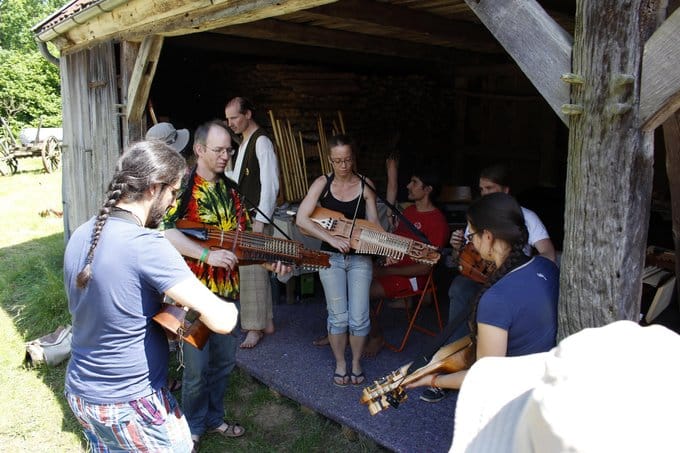
More instrument makers may be added in the future. If you’re interested, you can click on the instrument maker’s photo to visit their website.

Folk Songs Newfound Contest

The KlangRauschTreffen Folk Song Rediscovery Contest, which took place in 2022, will enter its second round due to its great success. The goal of the contest is to showcase new, previously undiscovered folk songs. Although there are many collections of folk songs, the same well-known songs are constantly being rearranged. The competition aims to bring these undiscovered songs to the public’s attention. Participants can perform a newly discovered song solo or with accompaniment and will be judged by an audience jury.
The winner will receive either a €50 gift certificate from deutschtradshop.de or free admission for two people to the 2024 KlangRauschTreffen. Original compositions or musical arrangements are not permitted. The contest will take place on KlangRausch Sunday at 12:30 p.m. at the Brümmerhof, and the winner will be announced during the evening concert. Those interested must register in advance via email and can find inspiration online from various sources. There is also a list of well-known songs that serve as examples. The KlangRausch team—consisting of Matthias Branschke, Vivien Zeller, and Merit Zloch—looks forward to the participants’ entries.

Secure tickets now!


Further contributions:

Posted on — Leave a comment

Discover dance music: If you want to get to the source, you have to swim against the current

Merit Zloch is an art historian and archaeologist from Berlin. In her guest article, she describes the exciting safari in search of German trad and dance music.

How did this all start with the regional dance music sources? When I began writing this “eyewitness account,” I couldn’t remember when the “Dahlhoff Dance Collection” had been digitized. Was it in 2011 or 2012, when colleagues and friends pooled their money to have the notebooks digitized?

The Dahlhoff Collection

I had to look it up. It was 2012, eight years ago now. It feels longer, though, because a lot has happened since then in terms of “dance music from German sources”. The digitization of the 10 octavo booklets aroused our curiosity for more and got the ball rolling. Music from dance music manuscripts from German-speaking countries is now not only played at sessions, but can also be found on CDs and interests European neighbors near and far.

For the first time since the rediscovery of the Dahlhoff—even before the digitized version was made available online—music is being performed from it. Pipenbock Music Workshop 2012.

But back to what is probably the best-known rediscovered archive – the “Dahlhoff Dance Collection” from the period between 1767 and 1799, written down by a sexton in a village near Bielefeld. The story that preceded the digitization is a little Indiana Jones adventure – not in distant, wild lands, however, but in the internet and library.

The digitization of found objects

While searching for exciting melodies for his band Malbrook, Wolfgang Meyering, a musician[fn]and radio presenter from Emden[/fn], was delighted to come across handwritten dance music with German-language names in the digital collection Svenskt visarkiv. These were transcriptions made by a certain Nils Dencker. This man – a Swedish ethnologist – was apparently on the lookout for Polonese melodies in the 1930s, including in Berlin. He copied Polonese tunes from the “Dahlhoff Dance Collection” and brought them back to Sweden.

Wolfgang Meyering told Simon Wascher, hurdy-gurdy player[fn], dance and music researcher from Vienna, about his find at http://simonwascher.info/[/fn], who was also researching the Polonese at the time. He traveled to Berlin and found the original in the Staatsbibliothek Unter den Linden. As far as the size of the source was concerned, his expectations were along the usual lines: everything between a few loose sheets and an octavo booklet. To his great surprise, however, he was presented with 10 bound booklets. It quickly became clear that it would make a lot of sense to have the booklets digitized. So we joined forces with a total of 13 people and made the digitization possible.

Of companions and dangerous sources

My friends and colleagues had long since developed an interest in music from German sources, and we inspired one another. Dr. Ralf[fn]Gehler, a music ethnologist and musician from Schwerin, http://tradmusikzentrum.de/[/fn] has been interested in dance music manuscripts and the like for decades and continues to unearth amazing discoveries time and again. Vivien[fn]Zeller, a musician from Berlin and co-editor of “Neues aus alten Büchern,” http://www.vivienzeller.de/[/fn], has been interested in German traditional music ever since she started making music. Matthias[fn]Branschke, a musician and instrument maker from Wittenberg, www.dudelsackmanufaktur.de[/fn] As a teenager, he discovered a highly dangerous source in his hometown—a pharmacist’s “poison book,” which had also been used as a music notebook. As an art historian and archaeologist with a particular fondness for sources, I have been fascinated by regionally transmitted music since the early 1990s.

And of course we weren’t the first to take an interest in the subject, to search for, find, play, record and spread this music! To name just two bands each from East and West with founding dates in the 70s: Folkländer, Horch, who inspired me a lot, Elster Silberflug, Zupfgeigenhansel.

In 20xx, Tramudera e.V. acquired a flea market find as part of a fundraising campaign—the violin method book of a certain August Dehmlow from Siedenbollentin (Vorpommern)
In 20xx, Tramudera e.V. acquired a flea market find as part of a fundraising campaign—the violin book of a certain August Dehmlow from Siedenbollentin (Vorpommern). The digitized version can be found here at http://tanzmusikarchiv.de/?page_id=514 (Photo: Merit Zloch)

The proud results of the research

Since 2013, we—primarily Vivien Zeller and Thomas Behr from Berlin—have been publishing a series called “New from old books” to share what we consider to be the greatest hits from these sources with interested musicians. Melodies from these songbooks can now be found not only in our concert and dance programs and on our CDs[fn]”Up blasen de lulleken pipe” (2000) and “Up frien foten” (1992-2002) by Ralf Gehler – “Malbook” (2004) and “Quade Wulf” (2008) by Malbrook – “hardigatti!” (2004) and “spring” (2006) by bilwesz – “urban legends” (2007) by Merit Zloch – “Liebeslieder im Rahmen der Möglichkeiten” (2018) by TradTöchter – “Abfahrt in 5 Minuten” (2019) by Harfenduo Zirla[/fn].

Among others, Faun, Deitsch, Zirp and various projects around Michael MöllersMichael[fn]Möllers is intensively involved in research into the Dahlhoff sexton family and their dance collection. http://dahlhoff-die-band.de/index.php/de/dahlhoff[/fn] have recorded wonderful interpretations of pieces from various music books.

I’d like to present a small, very personal selection of sources here in no particular order. If you’d like to get a sense of what’s out there—and there’s a lot at
!—I recommend starting with an audiovisual look at the YouTube channel“Tradtanzmusik.” I’d also like to recommend the website tanzmusikarchiv.de —and if you’d like to purchase issues of “Neues aus alten Büchern,” you can do so at deutschtradshop.de.


Further contributions:

    Posted on — Leave a comment

    Bagpipe maker Matthias Branschke gives 3 valuable tips for beginners

    Matthias Branschke is an instrument maker from Berlin. His range includes bagpipes based on French and Swedish models. Matthias is also a professional musician and lecturer at bagpipe workshops.

    In his guest article for Folk.World, Matthias gives valuable tips for bagpipe beginners and aspiring bagpipe players.

    Matthias Branschke, what is your motivation as an instrument maker?

    I started playing the bagpipes at the end of the 90s at the age of 12. Due to the folk revival in the 1970s, the bagpipe repertoire at that time was mainly French-inspired. I was lucky enough to have lessons with Ralf Gehler, who was one of the first bagpipers in Germany to explore our German tradition. He awakened in me the desire to rediscover this tradition and to allow my own creativity to flow into it. To this day, I mainly play new melodies by colleagues and myself, as well as traditional repertoire from the German-speaking world.

    And I became a bagpipe maker because I still see a lot of potential in the bagpipes, which you first have to tease out of them.

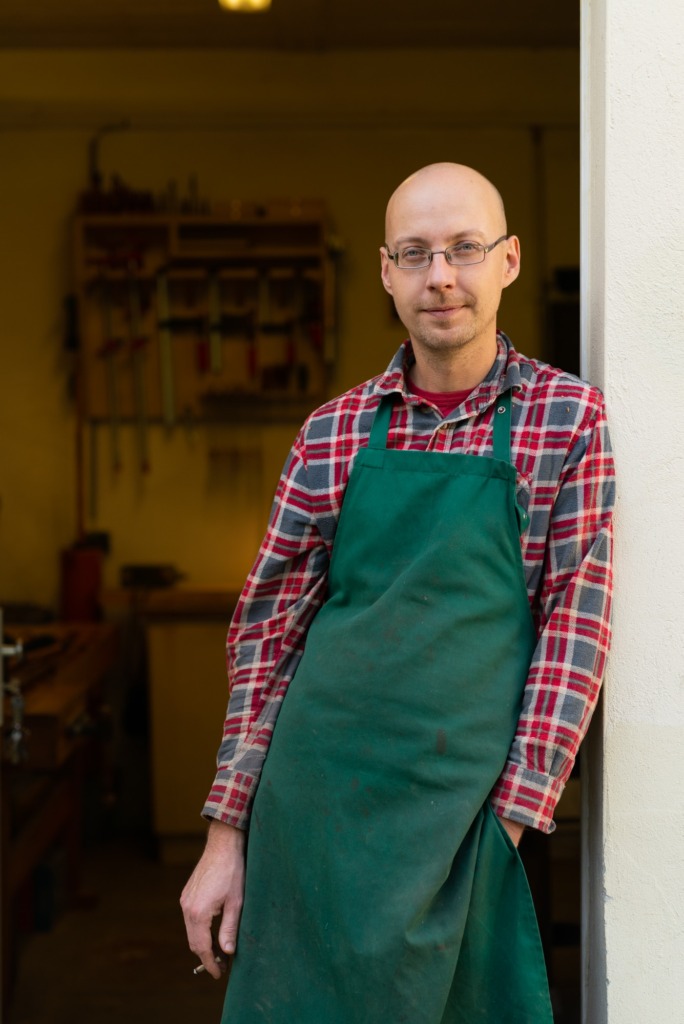
    Matthias Branschke stands in the doorway of his bagpipe manufactory

    Which bagpipes do you make?

    I make two different types of bagpipes.

    On the one hand, there are instruments with conically drilled chanter pipes and semi-closed fingering. These have a fairly wide range for a bagpipe, namely one and a half octaves, and are almost fully chromatic. I make these instruments in three different designs, namely

    • as a school instrument where the instrument is reduced to the essentials (a drone, blowpipe, chanter, bag and that’s it)
    • as a shepherd’s pipe, a historical design from the German-speaking world
    • and as a three-board instrument in which I install all the extras that seem useful to me as a musician on stage. The model runs under the name “Sessionprotz”.

    I also make Swedish Säckpipor (plural of “Säckpipa”), an instrument with a cylindrical chanter bore and a reed in the chanter. You can “only” play one octave on it, but I find the Säckpipa particularly suitable for traditional playing.

    How do I become a bagpiper?

    If someone wants to get into the world of bagpipes, I recommend one thing above all: talking to people who already play. Course weekends are a good opportunity to do this, and there are a lot of them regularly throughout Germany. The world of bagpipes is incredibly diverse.

    So if you still have no idea which of the 180 different types (!) of bagpipes you would like to play, I recommend that you attend a beginners’ course. In my opinion, the most flexible instruments for beginners are chanter pipes with semi-closed “French” fingering. Starting with such an instrument opens doors. You can always change over when you know exactly where you want to go.

    If you want to play the bagpipes, you need one thing above all: patience. In principle, playing the bagpipes requires the same skills as any other instrument. You have to practise, and every now and then someone should check to make sure you’re not making mistakes.

    Unfortunately, the density of bagpipe teachers is nowhere near as good as for classical instruments. However, there are quite a few courses, and lessons via Skype are now also a good alternative. Then it’s just a case of practicing, practicing, practicing.

    Don’t get frustrated, no master has fallen from the sky yet, and with 20 minutes of practice a day you’ll make quick progress.

    How much does it cost to play the bagpipes?

    I think anything under 500 euros for a new instrument is probably a waste of money. There are some manufacturers who offer instruments in this price segment, but most of them are “Made in Pakistan” (no joke) and simply don’t work. It really starts at 1000 euros, but of course there is always room for improvement. It is best to get advice from an instrument maker or someone who has been playing bagpipes for a long time.

    What you should spend on lessons and courses depends on how much input you need. If you have the chance to visit a teacher from your region, you should take the opportunity. It usually starts at around 30 euros per hour. Courses – which should not be underestimated as a social event – usually cost upwards of 150 euros for a weekend.

    Which textbook would you recommend?

    There are only a few textbooks for the bagpipes on the market. Technically good, although actually designed for a French style of playing and therefore highly recommended, is “Dudelsack spielen” by Bernard Boulanger. If you want to broaden your technical knowledge a little, you can find some books for Scottish bagpipes and other “insular” bagpipe types in the English-speaking world, but apart from Boulanger’s book, there are no other textbooks for the bagpipe types that I play.

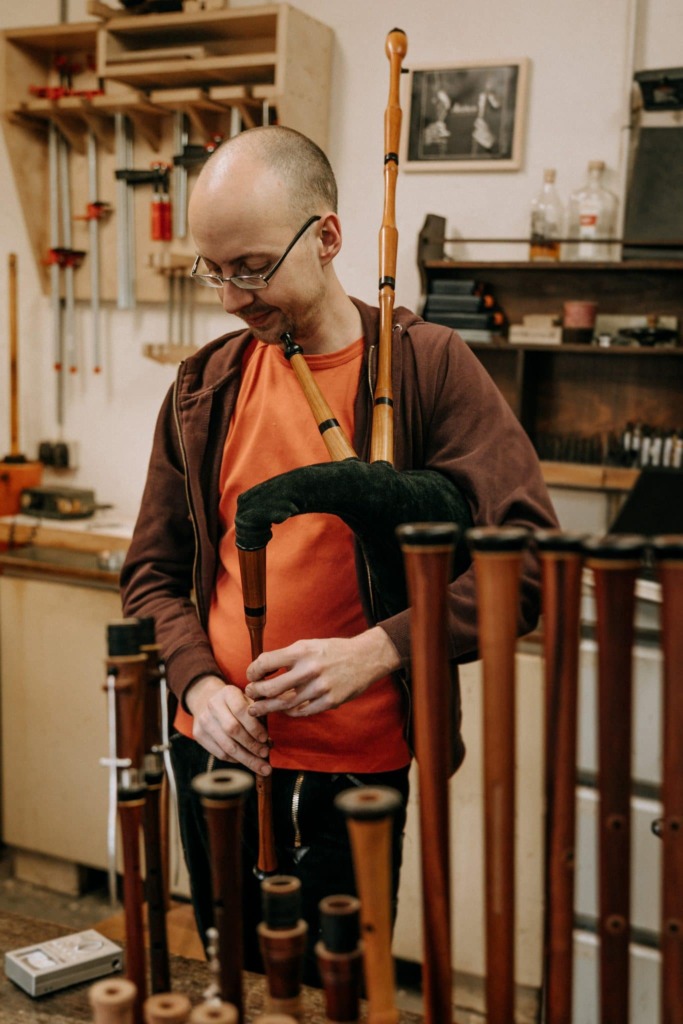
    Musician Matthias Branschke plays the school model of his shepherd's pipe

    Do the bagpipes come from traditional music?

    The bagpipes were the instrument of traditional music in almost all of Europe until the 18th century. The disco music of the time was played on them, so to speak. Of course, people have always wanted to dance, and a bagpipe can play well acoustically on its own, so you can keep the costs down at a dance evening, only need one musician and the party can start. The bagpipes are therefore inextricably linked with traditional music.

    Is there sheet music for traditional bagpipe music?

    All the sources of traditional music have been written down by fiddlers. Therefore, the pieces often do not fit directly on the bagpipes. With a bit of skill, many tunes can be adapted. If you want to embark on the journey, I can definitely recommend a bit of music theory. A group of people with whom I am quite good friends have studied the subject intensively. If you want to take a look: Dance music archive

    What would you like to pass on to us?

    Go for it! If you’re interested in the bagpipes, you should give them a try and check out the instrument at
    . The world of the bagpipes is incredibly fascinating and diverse, so it’s definitely worth a musical journey
    .


    Further contributions: